
Hi all, we've added https://www.wetmeadow.org/ as the new place for updates on the Children's Wet Meadow. :)
Saturday, August 27, 2022

Sunday, March 24, 2019
2019 prescribed burn - Tuesday 3/26/19 at 4:00 PM
It's one of our earliest burn dates ever! Please join us Tuesday for this safe, free, kid-friendly event.
Sunday, April 8, 2018
2018 Burn on April 9 at 4PM
The 2018 edition of the annual burn will be on April 9 at 4 PM, weather permitting.
Join us for seed collecting at 4PM, followed by the burn at 4:30PM.
Trained staff and volunteer from City of Ann Arbor Natural Area Preservation will explain the purpose of the burn and safety equipment and procedures.
Once the burn is safely complete, you can help re-distribute the seeds in the wet meadow.
Join us for seed collecting at 4PM, followed by the burn at 4:30PM.
Trained staff and volunteer from City of Ann Arbor Natural Area Preservation will explain the purpose of the burn and safety equipment and procedures.
Once the burn is safely complete, you can help re-distribute the seeds in the wet meadow.
Friday, June 23, 2017
Work Bee Monday June 26, 2017 6:30-8:00 PM
Come join neighbors and friends for a quick hour and a half of work to improve Buhr Park.
Meet us...
Work to be done:
Meet us...
- Buhr Park Children's Wet Meadow work bee on Monday June 26 from 6:30 - 8:00 PM
- Meet at the playground near the tennis courts
Work to be done:
- Clean up the path to the bench
- Pull woody plants from the graduate grove and palace of nature
- Learn what the graduate grove and palace of nature are
- Remove invasive thistle from wet meadow 3 (time permitting)
- Sit on the bench and enjoy a moment of peace
Sunday, May 21, 2017
The lupines are coming, the lupines are comng!
Lupines are one of my favorite native plants. The blossoms are a delicate purple color. And they attract many butterflies, bees and other pollinators.
I'm delighted that lupines are blooming in two places in Buhr park. One is the sand prairie in the upper (north) basin of WM II, on the west side of the park behind the swimming pool.

The other is in the original Wet Meadow, at the base of the sledding hill, on the east side of the park.


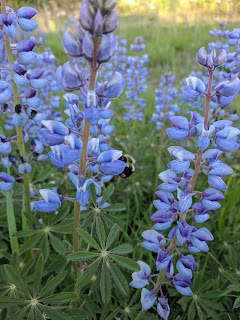

I'm delighted that lupines are blooming in two places in Buhr park. One is the sand prairie in the upper (north) basin of WM II, on the west side of the park behind the swimming pool.

The other is in the original Wet Meadow, at the base of the sledding hill, on the east side of the park.

Here are a few shots of pollinators in action!


Tuesday, May 9, 2017
Tickle Bees at Buhr - April 2017
This was a good year for tickle bees at Buhr. These bees nest in the ground, in the upper basin behind the swimming pool. We call them tickle bees because they are harmless to humans. The ones we see on sunny days in April are males, cruising at about 12 inches above the ground, looking for partners.Fun fact: male bees have no stingers.
Here's some info from a school in Oregon:
http://www.sabinpta.com/tickle-bee
Our tickle bees are probably in the genus, Colletes.They are also called, "cellophane bees" since they line their nests with a cellophane-like substance.

Here's some info from a school in Oregon:
http://www.sabinpta.com/tickle-bee
Our tickle bees are probably in the genus, Colletes.They are also called, "cellophane bees" since they line their nests with a cellophane-like substance.

Monday, April 10, 2017
2017 prescribed burn excites children and adults
The prescribed ecological burn on April 10, 2017 was an exciting event for children and adults. Trained staff and volunteer from City of Ann Arbor Natural Area Preservation explained the purpose of the burn and described safety eqiptment and procedures. Since the wind was coming from the south, they started the burn at the northern edge. Here's what it looked like when the flames were closer to the viewers.

A few moments after this picture, we started to feel raindrops! So this is the first burn on record where it rained at the end of the burn. Kids and parents went home, so we'll plant seeds sometime later this week.

A few moments after this picture, we started to feel raindrops! So this is the first burn on record where it rained at the end of the burn. Kids and parents went home, so we'll plant seeds sometime later this week.
Monday, April 3, 2017
2017 Prescribed Burn -- re-scheduled for Monday April 10
Our annual prescribed burn has been postponed until Monday, April 10, 2017.
To achieve the desired results, plant materials must be dry and humidity low. Wind speed and direction are important for smoke control. Based on the updated weather forecast, prospects for Monday look good.
As originally planned, we will collect seeds starting at 4:00 PM. About 4:30, trained staff from Natural Area Preservation (City of Ann Arbor) will explain their equipment and safety precautions. Then everyone will watch from a safe distance.This year's burn will be held at the north-west quadrant of the park, north of the ice rink, near the east end of Essex Street.

This is a family-oriented event and we emphasize safety. Children of all ages enjoy watching with their parents. Everything is explained in simple language. Kids can see protective clothing and special tools, including the world's largest squirt guns (water-carrying backpacks with spray nozzles, used to control the fire.)
 In case of adverse weather, we will re-schedule on a day-by-day basis.
To achieve the desired results, plant materials must be dry and humidity low. Wind speed and direction are important for smoke control. Based on the updated weather forecast, prospects for Monday look good.
As originally planned, we will collect seeds starting at 4:00 PM. About 4:30, trained staff from Natural Area Preservation (City of Ann Arbor) will explain their equipment and safety precautions. Then everyone will watch from a safe distance.This year's burn will be held at the north-west quadrant of the park, north of the ice rink, near the east end of Essex Street.

This is a family-oriented event and we emphasize safety. Children of all ages enjoy watching with their parents. Everything is explained in simple language. Kids can see protective clothing and special tools, including the world's largest squirt guns (water-carrying backpacks with spray nozzles, used to control the fire.)

Friday, May 13, 2016
Lupines in Bloom
An early morning walk revealed beautiful lupines in bloom. The sandy area at the north end of Wet Meadow 2.


Friday, April 15, 2016
Tickle bees at Buhr - April 2016
Tickle bees are emerging at Buhr Park thgis weekend. Look in sandy places for holes (about pencil-diameter) and mounds of soil. The stingless male bees may be buzzing around about 8 -12 inches above the ground.
 These are ground-nesting bees of genus Andrena or genus Colletes. The
eggs hatch in early Spring, and the new adults dig their way to the
surface. The males fly around looking for partners. They eat nectar from
violets and other plants that bloom very early. They are a sure sign
that Spring is here.
These are ground-nesting bees of genus Andrena or genus Colletes. The
eggs hatch in early Spring, and the new adults dig their way to the
surface. The males fly around looking for partners. They eat nectar from
violets and other plants that bloom very early. They are a sure sign
that Spring is here.

Monday, April 4, 2016
2016 Burn was successful on Tuesday, April 5
Due to weather conditions, the was re-scheduled to Tuesday, April 5.The weather was sunny and cool. A breeze helped the smoke lift and disperse.
Many children, parents and neighbors helped with seed collection and dispersal. All watched the burn from a safe distance.
As usual, we spent time explaining why the wet meadows are important and why controlled burning helps the native plants.

Many children, parents and neighbors helped with seed collection and dispersal. All watched the burn from a safe distance.
As usual, we spent time explaining why the wet meadows are important and why controlled burning helps the native plants.

Saturday, March 26, 2016
Wet Meadow Burn 2016 Edition: April 4, 4:30 PM

The annual burn at the Buhr Park Children's Wet Meadow(s) will be on Monday April 4, 2016 at 4:30 PM. Come earlier and help out and watch as burns progress through other parts of the park.
The burn is weather-dependent, so check back in here or on Facebook for updates.
Location:
Buhr Park
2751 Packard Rd.
Ann Arbor, MI 48104
Sunday, April 26, 2015
"Tickle bees" at Buhr

You may have seen this video about "tickle bees" at an elementary school in Portland, OR.
http://www.katu.com/familymatters/go_green/TICKLE-BEES-255872371.html
These are stngless, solitary native bees that nest in bare soil (in this case a school playground. ) For several years the Oregon children have been playing with them in early Spring, and call them "tickle bees". (Scientist call them Adrena sp.)
We are lucky to have some of these amazing insects in the Buhr Park Childrens Wet Meadows.They especially like the bare soil in the upper basin of Wet Meadow II.(This is behind the swimming pool, closest to the ice rink.)
Have you seen their little cones and dirt piles? This time of year, you may also see males cruising about 12 - 14 inches above the ground. (There's a great shot of this in the Oregon video.) Sunny days are best to see the bees in flight.
Monday, July 21, 2014
Volunteer Stewardship Event
Friday, July 25, 6:30-8:30pm
In BUHR PARK
(north end of gravel parking lot)
*Learn about this project that provides a habitat for native plants and animals,
an
attractive educational site for children, neighbors and other visitors,
an environmental filter for storm water runoff from the park grounds,
and most recently, a model for exploring
the integration of native plants and food production.
*Tour the 3 wet meadows and the new food forest.
*Dig in and help spread woodchips, pull weeds, plant, mulch. Bring your favorite tools;
gardening attire recommended.
*Bring family, friends and neighbors. All ages welcome.
Refreshments provided. Bring your own drinking cup.
For more information or to learn more about the project: email or call -
Sunday, July 13, 2014
Wet Meadow Two - 10th Anniversary!
A team of teens and community volunteers planned and planted the second wet meadow in Buhr Park 10 years ago this summer. It is getting along famously and servings its purposes of capturing rainwater that falls in the park and nearby neighborhoods and making the park a more interesting place for people and critters of all shapes and sizes.
The most interesting feature of wet meadow 2 is the sand zone at the north end. When excavating we were surprised to discover such a sandy area. It has turned out to be a wonderful habitat for cacti, bluestem, and killer wasps.


The most interesting feature of wet meadow 2 is the sand zone at the north end. When excavating we were surprised to discover such a sandy area. It has turned out to be a wonderful habitat for cacti, bluestem, and killer wasps.
Sunday, June 29, 2014
Butterfly Observations
A
local expert in butterfly identification visited the wet meadows
recently, with particular attention to the sandy upper basin behind the
swimming pool.
He saw cabbage white, long dash, Peck's skipper, Ringlet, red admiral, silver-spotted skipper, and banded hairstreak butterflies. The banded hairstreaks were visiting the butterfly weed.
He saw cabbage white, long dash, Peck's skipper, Ringlet, red admiral, silver-spotted skipper, and banded hairstreak butterflies. The banded hairstreaks were visiting the butterfly weed.
Monday, March 17, 2014
2014 Wet Meadow Burn - April 9

City of Ann Arbor natural area program staff conduct the annual prescribed burn of the wet meadows.
This year we burned Wet Meadow 2, Wet Meadow 3, the parking lot swale, and several other native plantings. We are hoping to burn Wet Meadow 1 and Wet Meadow 1 extension later in the spring to help control crown vetch.
Burns help manage native landscapes by clearing out old growth, fighting back non-native plants that are not fire-adapted, and preparing the ground for spring growth.


Sunday, March 17, 2013
Come celebrate on Tuesday, April 2, 2013
Join us to welcome Spring with the annual prescribed burn at Buhr Park Children's Wet Meadow! Starting at mid-afternoon, trained experts from the City of Ann Arbor's Natural Area Program will explain safety measures, then ignite last year’s dry stems and leaves. 

One parent says, "It's quite a sight - my daughter has gone to prescribed burns from age 2 and loves them. I think it's quite safe for kids of any age if they're with a parent."
Although burning may seem destructive, fire actually serves to stimulate vigorous new growth of native plants, controls the invasion of undesirable plants, warms the soil and releases nutrients. Fire allows diverse native plant and animal communities to thrive in natural areas.
After the fire is safely out, children will scatter seeds that were collected last Fall, and dance or sing to encourage new growth. In a few weeks the meadows will be springing back to life, better than ever.
If the weather permits, consider bringing a picnic supper. Come and go when you like. The event is free and open to the public. Buhr Park is in east Ann Arbor, at 2751 Packard (on the north side of the street) between Eisenhower and Platt. Children must be accompanied by a parent.
Saturday, March 9, 2013
Super Swampers Spring Planning
Super Swampers met today to plan activities for the year. We spent time thinking about what we liked about the wet meadows and the project and then brainstormed things we'd like to do.

- It helps the environment
- The flowers and the birds
- Community
- Bringing beauty to our park
- Flowers
- Helps animals live
- Habitats for animals
- Playing, plants, water, smiles, laughing
- Making or planting things (6)
- Food (4)
- The Burn (4)
- Signs and awareness (4)
- Animals (3)
- Play/Fun (2) - but we always have fun
- Taking care of it (1)


Sunday, August 19, 2012
Wet Meadows in a Drouth Year
As awareness grows on the impact of this summer's widespread drouth across the central US, it's interesting to look at the wet meadows in Ann Arbor's Buhr Park. Wet meadows, like many artificial "rain gardens," feature native plants that can thrive when occasionally inundated, and that grow and bloom even if they have "wet feet" for days or weeks at a time.

So how have they handled this year's drouth?
Exhibit A, in very sandy soil (upper basin on west side, almost behind the locker rooms, says "Drouth, what drouth?". It's growing bigger, to catch more sun.
Well, you say, cacti are a special case. So let's hear from someone else.
Exhibit B says,"I'm happy and healthy, thanks." This shrub (Ptelea trifoliata or wafer-ash)is also in that sandy upper basin. For plants that thrive on sand dunes, every year is a dry year.

Take a look for yourself. I think you'll agree that many, perhaps most of the plants are doing just fine, with no supplemental watering. A community of diverse species, well-established and appropriate to the site and soils, is remarkably resilient.
Subscribe to:
Posts (Atom)